Skip to content


Anyone disposing of old IT hardware often reads the term "certified waste management company" in quotes. It sounds like a formality, but it is one of the most important questions when choosing a service provider. As a company, you remain responsible for your waste until it has been properly recovered. This article explains what a certified waste management company is, what obligations the Electrical and Electronic Equipment Act imposes on companies and how you can recognize legally compliant IT disposal.
The most important in a nutshell
- A certified waste management company is a company that is certified under § 56 of the German Circular Economy Act for certain waste management activities and is reviewed regularly.
- The certificate applies only to the activities, waste types and sites named in it. It is worth taking a look at the document.
- Under the ElektroG, companies must collect old devices separately, remove batteries and have personal data erased themselves.
- Reuse comes before recycling: functional IT should first be refurbished and kept in use.
What is a certified waste management company?
A certified waste management company (EfB for short) is a business that collects, transports, stores, treats, recovers, disposes of, trades in or brokers waste and is certified for this under § 56 of the German Circular Economy Act (KrWG). The requirements for organization, equipment, personnel and reliability are set out in the Ordinance on Waste Management Companies (EfbV). Certification is carried out by a technical inspection organization or a waste management association. The certification is time-limited and is reviewed annually.
For you as the client, the certificate is proof of quality: the company has trained personnel, suitable facilities and an organization that handles waste in a traceable and legally compliant manner.
What to look for in the certificate
| Information in the certificate | Why it matters |
|---|---|
| Activities | Collecting, transporting, storing, treating, recovering: the certificate applies only to the activities named. |
| Waste types (waste codes) | For IT hardware, the codes 16 02 13*, 16 02 14, 20 01 35* and 20 01 36 of the German Waste Catalogue Ordinance are particularly relevant. The asterisk marks hazardous waste. |
| Site | The certificate relates to specific business sites. |
| Validity | An expired certificate is not proof. Check the date. |
| Certification body | Technical inspection organization or waste management association. |
Rule of thumb: "certified waste management company" is not a title for everything. What matters is whether the certificate covers exactly the activity and the waste type that your case involves.
What obligations the ElektroG imposes on companies
The Electrical and Electronic Equipment Act (ElektroG) transposes the European WEEE Directive 2012/19/EU into German law. It regulates how waste electrical and electronic equipment is collected, treated and recovered. For companies as owners of old devices, the following mainly applies:
- Collect separately: Old devices do not belong in residual waste or mixed commercial waste.
- Remove batteries: Used batteries and rechargeable batteries that are not enclosed by the device and can be removed without destroying it must be removed beforehand.
- Erasing data: Under § 10 ElektroG, end users are themselves responsible for erasing personal data on old devices before disposal.
- Take-back of commercial devices: For devices that do not come from private households, manufacturers are in principle obliged to take them back under § 19 ElektroG. Deviating agreements are possible.
Wichtig ist der Punkt Datenlöschung: Weder der Entsorger noch der Hersteller übernimmt diese Verantwortung automatisch. Wenn Sie einen Dienstleister damit beauftragen, sollte das ausdrücklich im Auftrag stehen, mit Nachweis je Gerät. Bei Second IT werden Datenträger vor der Verwertung zertifiziert gelöscht oder – wenn das nicht möglich ist – Data carriers destroyed beforehand, in accordance with DIN 66399 and certified for security level H-5.
This article does not replace legal advice. Depending on the waste type and quantity, further obligations may exist, for example under the Waste Verification Ordinance or the Commercial Waste Ordinance.
Terms related to IT disposal
| Term | Significance |
|---|---|
| ElektroG | Electrical and Electronic Equipment Act. Regulates the placing on the market, take-back and disposal of electrical equipment in Germany. |
| WEEE Directive | European Directive 2012/19/EU on waste electrical and electronic equipment (WEEE). |
| KrWG | Circular Economy Act. Among other things, it sets out the waste hierarchy and the rules for certified waste management companies. |
| Certified waste management company (EfB) | Business certified under § 56 KrWG for the activities and waste types named in the certificate. |
| Initial treatment | First treatment step of an old device after collection, such as removal of pollutants and dismantling. It may only be carried out in certified initial treatment facilities. |
| Preparation for reuse | Checking, cleaning and repairing so that an old device can be used again without further pretreatment. |
Why the topic is becoming more important
E-waste is the fastest-growing waste stream in the world. According to the United Nations Global E-Waste Monitor 2024 (UNITAR and ITU), 62 million tonnes of e-waste were generated worldwide in 2022. Only 22.3% of this was verifiably collected and recycled. Since 2019, the EU directive has set a collection rate of 65%. According to the German Environment Agency, Germany has been well below this for years. You will find more figures in our article with facts about e-waste.
For companies, this means that customers, auditors and reporting obligations increasingly ask more precisely what happens to retired IT. Anyone with clean documentation of the remarketing process can also use it for sustainability reporting – for example for the Scope 3 emissions of IT.
Reuse first, then recycle
The German Circular Economy Act sets out a clear order of priority in § 6, the so-called waste hierarchy:
- Avoidance
- Preparation for reuse
- Recycling
- other recovery, for example energy recovery
- Elimination
For IT hardware this means: recycling a functional notebook is not the best solution. It is better to erase, refurbish and continue using the device. This is exactly where Second IT comes in: functional devices go into refurbishment for a second life – according to the company, more than 180,000 devices have already been refurbished. Only what is no longer usable is dismantled and recycled. Further strategies are described in our article on avoiding e-waste.
What legally compliant IT disposal looks like
- Record contents: Device type, manufacturer, model, serial number and condition.
- Data and value check: Which devices have data carriers, and which still have a market value?
- Service providers check: Certificate as a certified waste management company, waste codes, data protection certificates, data processing agreement.
- Secure transport: Sealed, documented, without intermediate storage.
- Data erasure or destruction: With proof per serial number.
- Recovery according to the waste hierarchy: Reuse before recycling.
- Pollutants: Batteries, rechargeable batteries and other hazardous components are separated and treated properly.
- File the records: Erasure and destruction certificates, disposal records, and where applicable an environmental balance.
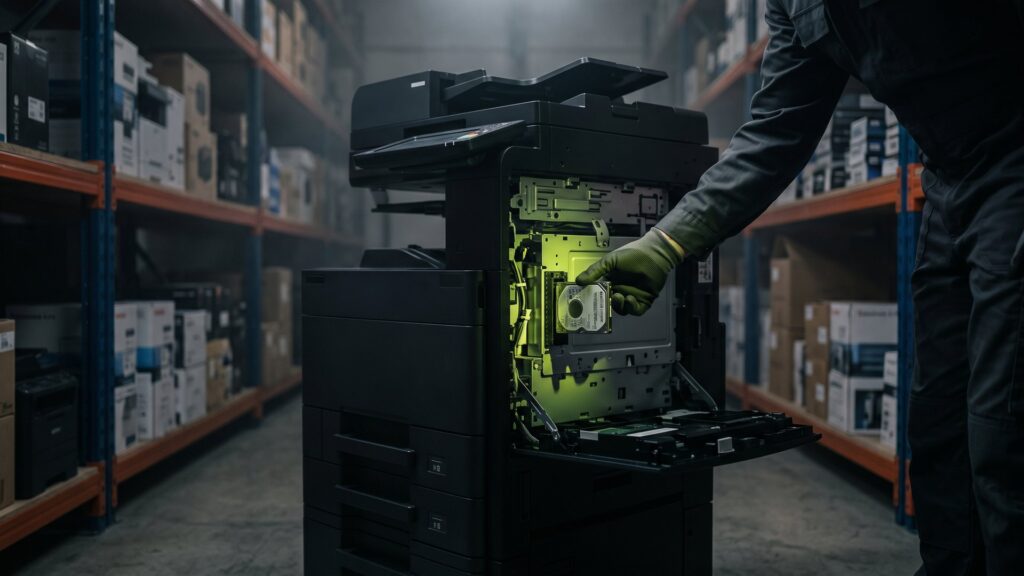
A frequently overlooked case is multifunction devices – more on this in the guide Disposing of printers and copiers with hard drives.
What Second IT covers as a certified waste management company
Second IT is a certified waste management company under § 56 KrWG. In addition there are management systems in accordance with ISO 9001, ISO 14001, ISO 45001 and ISO/IEC 27001. You will find the certificates on the page with the Second IT certificates.
The IT disposal under the German Circular Economy Act includes the dismantling of devices, the safeguarding of functional components, the proper treatment of pollutants and the recovery of raw materials such as metals and plastics. According to its own information, Second IT has already safely disposed of around 200,000 devices. You receive recycling and disposal records that you can use for CSR and ESG reports, and on request also an annual, individual environmental balance.
Typical mistakes when disposing of IT hardware
- Old devices in commercial waste: Monitors, keyboards or power adapters end up in the mixed container even though they are waste electrical equipment.
- Batteries stay in the device: Lithium batteries in notebooks and smartphones can cause fires if handled incorrectly. They belong in separate collection.
- Data is forgotten: The device is disposed of properly, but nobody has erased the hard drive. Under § 10 ElektroG, this is your responsibility.
- Recycling before reuse: Functional devices are shredded even though they could have a second life.
- No records: In the end there is only an invoice, but no list of which devices were recovered and how.
- Expired certificates: The service provider was once a certified waste management company, but the current certificate is missing.
Checklist: choosing the right disposal partner
- Is there a valid certificate as a certified waste management company that covers the activity, waste type and site?
- Are data carriers erased or destroyed before recovery, with proof per serial number?
- Is there a data processing agreement under Art. 28 GDPR?
- Are functional devices reused instead of being recycled immediately?
- What does the transport look like, and who carries it out?
- What documentation do you receive at the end, and is it suitable for your reports?
More on the topic: How to turn your IT into a closed-loop model: 5 recipes for success and Bye-bye throwaway culture - IT can also be different.
Frequently asked questions about certified waste management companies and the ElektroG
What is a certified waste management company?
A certified waste management company is a business that is certified under § 56 of the German Circular Economy Act for certain waste management activities. The requirements are set out in the Ordinance on Waste Management Companies. Certification is carried out by a technical inspection organization or a waste management association, and the certification is reviewed annually.
Do I have to dispose of IT hardware through a certified waste management company?
There is no general obligation to do so, but you remain responsible for the proper disposal of your waste. A certified waste management company gives you the assurance that organization, personnel and facilities have been audited. For commercial old devices, the manufacturers' take-back routes under § 19 ElektroG are also possible.
Who is responsible for data erasure under the ElektroG?
The end user, i.e. your company. § 10 ElektroG makes clear that end users are themselves responsible for erasing personal data on old devices. You can commission a service provider to do this. You should then receive an erasure or destruction record for each device.
Which waste codes apply to old IT devices?
Often these are 16 02 13* and 16 02 14 for used devices from commerce and industry, and 20 01 35* and 20 01 36 for devices from municipal waste. The asterisk marks hazardous waste. The exact classification depends on the device. Your disposal partner will help with the classification.
Dispose of IT hardware – legally compliant, with data erasure and reuse before recycling.
Send us your device list. You will receive your offer in 48 hours on average.