Skip to content

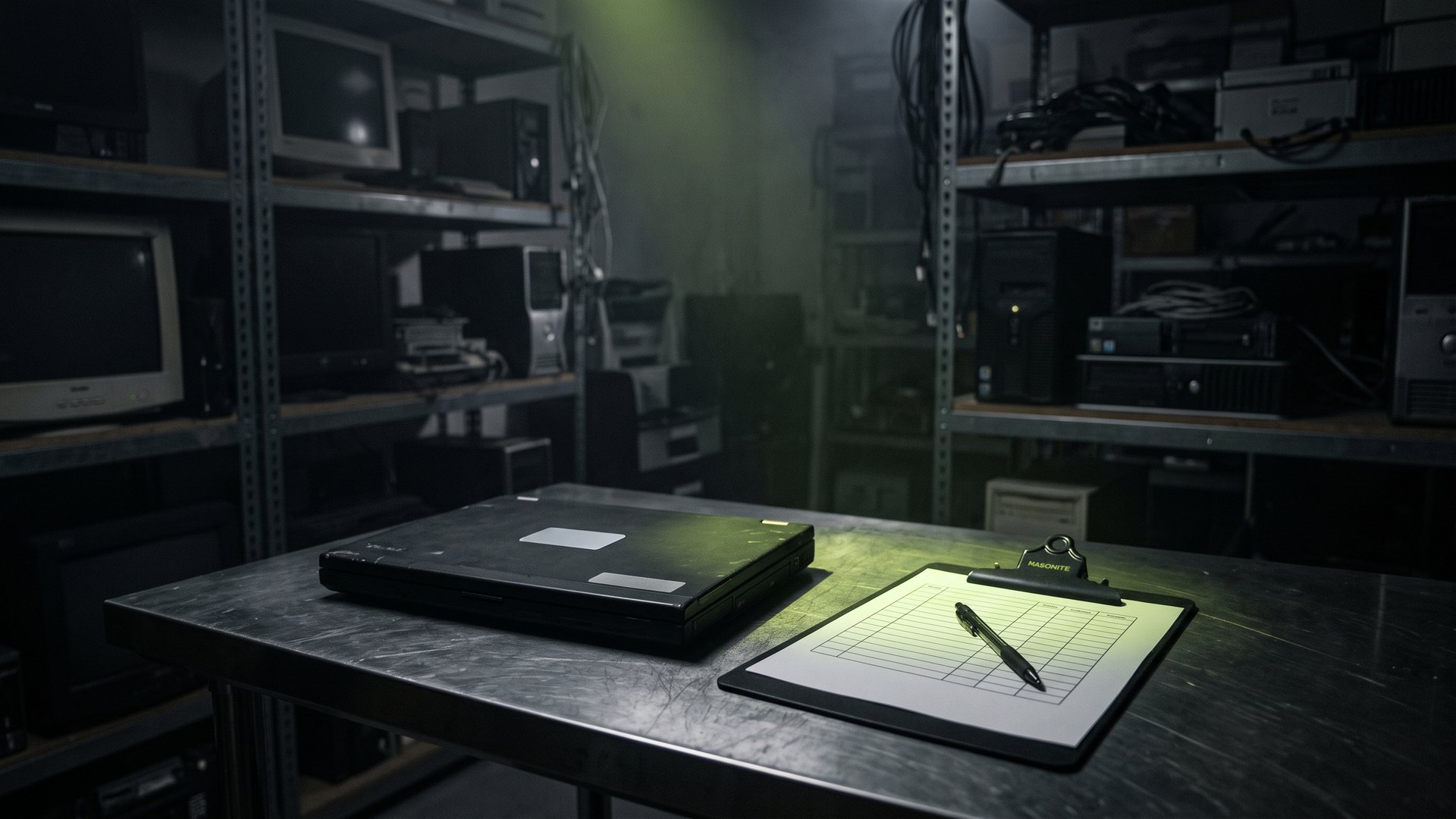
A laptop is fully depreciated, defective, or simply surplus. IT puts it in storage, and at some point a disposal company picks it up. And in fixed asset accounting, the device stays on the list. At the next inventory count or tax audit, the gap is noticed. A scrapping report closes it. This article explains what a scrapping report for IT hardware should contain, how the asset disposal is documented, and why "scrapping" is often the most expensive type of disposal.
The most important in a nutshell
- A scrapping report is the internal record that an asset has been removed from fixed assets because it was disposed of.
- It should state the inventory number, serial number, reason, date, residual book value, and whereabouts – and be signed by two people.
- For IT hardware, erasure or destruction records and the disposal record are attached.
- Many "scrap devices" still have a market value. A sale instead of scrapping brings proceeds instead of costs.
What is a scrapping report?
A scrapping report (also scrapping voucher or disposal voucher) is an internal document. It records that an item of fixed assets is no longer used but has been disposed of. For accounting, it is the voucher for booking the asset's disposal. For the inventory count, it explains why a device is no longer present. And for data protection, it links the device to the proof that its data was erased or destroyed.
The background is the obligation to keep proper books. Under § 240 HGB, merchants must regularly draw up an inventory, and every entry needs a voucher. A device that disappears from the inventory without a voucher is a gap in the documentation.
The different types of asset disposal
| Type of disposal | Example | Typical voucher |
|---|---|---|
| Sale | Purchase by an IT remarketer, sale to employees | Invoice or credit note, handover record |
| Scrapping | Disposal of a defective device | Scrapping report, disposal record |
| Return | Return of leased devices to the lessor | Return record (leased devices are generally not in your fixed assets) |
| Donation or gift | Transfer to a charitable organization | Donation receipt, handover record |
| Loss or theft | Laptop does not come back | Loss report, police report where applicable |
What belongs in a scrapping report
There is no legally prescribed form. These details have proven their worth:
- Inventory or asset number from the fixed asset register
- Device description: Device type, manufacturer, model
- Serial number of the device and, for IT, of the installed data carriers
- Acquisition date and acquisition cost
- Residual book value and the book value at the time of disposal
- Reason for disposal: defective, obsolete, repair uneconomical
- Date of disposal
- Whereabouts: Name of the disposal company or recycler
- Data protection: Reference to the erasure or destruction certificate
- Signatures: two people, for example from IT and accounting
- Attachments: Disposal record, erasure or destruction certificate
Template: structure of a scrapping report for IT
| Field | Example content |
|---|---|
| Inventory number | Number from the fixed asset register |
| Device | Laptop, manufacturer, model |
| Serial numbers | Device and installed SSD |
| Acquisition | Date and acquisition cost |
| Residual book value | Value on the day of disposal, often 0 euros |
| Reason | Mainboard defective, repair uneconomical |
| Disposal date | Day of handover to the disposal company |
| Whereabouts | Name of the certified waste management company |
| Data protection | Number of the erasure or destruction certificate |
| Approval | Signatures of IT and accounting with date |
For larger quantities, you do not have to create a separate sheet for each device. A collective report with one line per device is common and clearer.
It is practical to generate the report directly from the fixed asset register: you export the affected assets as a list, add the reason and whereabouts, and have the list approved by IT and accounting. The serial numbers from this list then serve at the same time as the basis for the recycler's quote and for the later reconciliation with the erasure certificates.
Rule of thumb: With IT hardware, every scrapping report comes with a record about the data. A scrapped device is not automatically an erased device.
Why the data protection attachment is so important
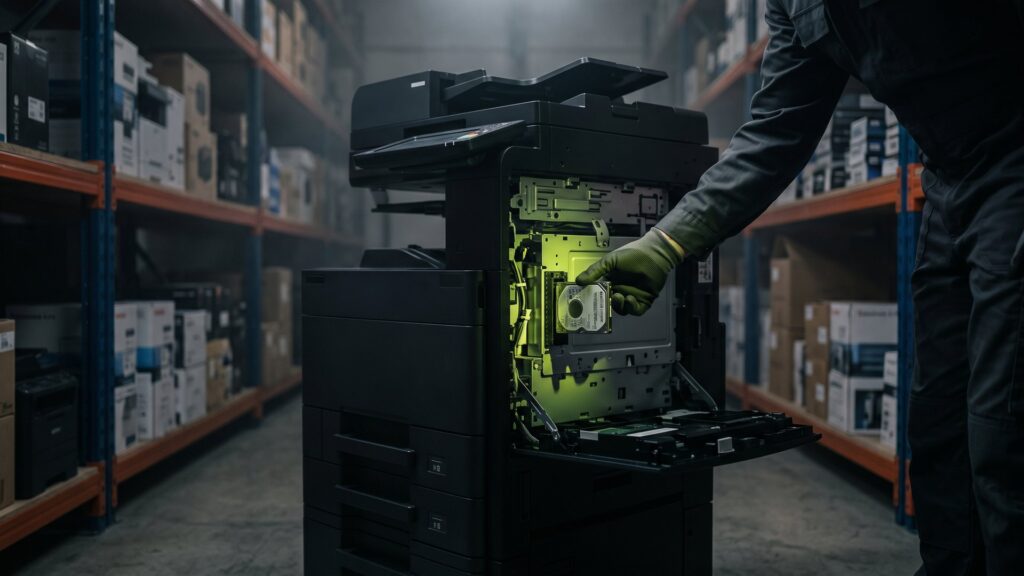
"Scrapped" does not mean the hard drive was destroyed. Many devices are dismantled, and their components go into recycling. If a data carrier is passed on unerased in the process, you have a data protection problem – despite proper bookkeeping. Therefore link every scrapping report to an Certificate of destruction per device or a certificate of destruction with a serial number.
How the disposal is booked
When an asset is retired, it is booked out of fixed assets at its residual book value. In principle:
- Scrapping: Any remaining residual book value is booked as an expense. If the device is fully depreciated, no expense arises any more, but the disposal must still be documented.
- Sale: The residual book value is offset by proceeds. If the proceeds exceed the residual book value, a gain arises. The sale of fixed assets is generally subject to VAT.
- Collective item: Devices recorded in a collective item under § 6(2a) EStG are not booked out individually when they are retired. The collective item continues to be depreciated unchanged.
Since 2021, computer hardware and software can be depreciated for tax purposes over a useful life of one year. Many IT devices therefore have a book value of zero early on. More on this in our article on useful life and depreciation. Please clarify the specific booking and tax treatment with your tax advisor. This article does not replace tax advice.
Retention
Scrapping reports are accounting vouchers. Since 2025, a retention period of eight years applies to accounting vouchers (§ 147 AO, § 257 HGB). You should keep erasure and destruction records together with the report for at least as long.
Selling instead of scrapping
In many companies, devices are scrapped that actually still have a market value: three-year-old laptops with a weak battery, monitors with minor scratches, servers from a completed migration. A fully depreciated device is not worthless. If it is sold instead of scrapped, a disposal invoice turns into a credit note.
| Criterion | Scrapping | Sale to a certified remarketer |
|---|---|---|
| Economics | Disposal costs, no proceeds | Proceeds, often even for older devices |
| Voucher | Scrapping report and disposal record | Credit note or invoice and handover record |
| Data protection | Erasure or destruction record required | Certificate of destruction per device |
| Sustainability | Recycling of raw materials | Reuse of the whole device |
Second IT assesses your inventory with a inventory analysis with market valuation based on current price data. Devices with market value are bought back, and devices without market value are recycled properly. This way you receive the appropriate voucher for every disposal. Why this view is also worthwhile for the finance department is shown in our article on used IT hardware from a financial perspective.
Computers that still work often have a residual value – what matters when you Selling used PCsis explained in a separate guide.
Devices without market value: disposal with documentation
For devices that can no longer be sold, you need, in addition to the scrapping report, a record of proper disposal. Second IT is a certified waste management company under § 56 of the German Circular Economy Act. The devices are dismantled, usable components are secured, pollutants are treated properly, and raw materials are recovered. You receive Disposal certificatesthat you can attach to the scrapping report.
Process: from the storage shelf to a clean asset disposal
- Record contents: List all devices to be retired with inventory and serial numbers.
- Reconcile with the fixed asset register: Check residual book values and ownership. Treat leased devices separately.
- Obtain a valuation: Which devices can be sold, which have to be disposed of?
- Handover: Sealed pickup with handover record.
- Deletion or destruction: Certificate per serial number.
- Consolidate the vouchers: Credit note for sold devices, scrapping report and disposal record for the rest, erasure and destruction certificates for all.
- Book and file: Book the disposal in the fixed asset register, retain the vouchers.
Typical mistakes in IT asset disposal
- Devices disappear without a voucher: The laptop is gone, the fixed asset register still carries it. An unexplained discrepancy arises at the inventory count.
- Scrapping without proof of data handling: The booking is correct, but nobody can prove that the hard drive was erased or destroyed.
- Leased devices in the scrapping report: Devices that belong to the lessor are disposed of by mistake.
- Sale without an invoice: Devices go informally to employees or dealers. Proceeds and VAT are not recorded correctly.
- No four-eyes principle: A single person decides, scraps, and books. This is prone to errors and abuse.
Special case: the public sector
Authorities, municipalities, and school authorities usually speak of decommissioning (Aussonderung) rather than scrapping. In addition, budget-law requirements and internal decommissioning guidelines apply to them. For devices with classified information, special rules for erasure and destruction apply as well. More on this in our article on decommissioning in public authorities.
More on the topic: Returning a leased device to IT: Returning, replacing, or selling it? and IT managers take note: These values lie dormant in your hardware.
Frequently asked questions about the scrapping report
What is a scrapping report?
A scrapping report is an internal record that an asset of fixed assets has been disposed of. It states the inventory number, device, serial number, reason, date, residual book value, and whereabouts and is usually signed by two people. On this basis, accounting books the asset disposal.
Is a scrapping report required by law?
The law does not prescribe a specific form. However, every booking needs a voucher, and the inventory must be correct. The scrapping report is the usual way to document the disposal of a discarded device. How exactly you design it is best agreed with your tax advisor.
What else must be documented for IT devices?
For IT devices, a record about the data is part of it: an erasure certificate or a certificate of destruction with the serial number of the data carrier. Without this record, the disposal is booked, but it is not proven that the data was removed. The disposal record is added to this.
Do I have to book out fully depreciated devices at all?
Yes. Even a device with a book value of zero stays in the fixed asset register until it is booked out. The disposal then causes no expense any more, but must be documented. Only for devices in a collective item under § 6(2a) EStG is the individual booking out omitted.
Check before scrapping: which devices still bring in money?
Send us your list of devices to be retired. You will receive your quote in 48 hours on average – with erasure and disposal records for your accounting.