Skip to content

In the balance sheet, it is listed with zero euros; on the shelf, it is fully functional: the discarded company laptop. There is often a gap between the book value and the market value; many companies never take advantage of this. This article explains how laptops can be used tax-efficiently, technically and economically, and shows why the right time to sell brings more money than the longest period of use.
The most important in a nutshell
- From 2021, computer hardware and software can be depreciated tax-deductible over a period of one year. The classic AfA table lists three years.
- Being written off does not mean it is worthless: Many business laptops still have real market value after three to four years.
- The market value decreases with each month. Those who sell earlier usually earn more than they would have saved over another year of use.
- Selling to a certified remarketing provider combines revenue, data deletion, and proof.
Three types of usage duration
When talking about the „lifetime of a laptop,“ accounting, IT, and purchasing often mean different things. It helps to separate the three perspectives.
| Point of view | Question | Typical response |
|---|---|---|
| Taxable period of use | For how many years is the depreciation calculated? | 1 year possible (since 2021), classic 3 years |
| Technical service life | How long does the device work for? | Often significantly longer than the depreciation period |
| Economic useful life | When does the device cost more than it’s worth? | Depending on support, performance, outages, and residual value |
Depreciation: What applies tax-wise
According to the official AfA table, notebooks and PCs were depreciated for a long period of over three years. With a letter from the Federal Ministry of Finance from 2021, a one-year depreciation period was granted for computer hardware and software. Companies can therefore fully deduct the purchase costs in the year of purchase as an expense.
In addition, there are rules for low-value goods: devices up to 800 euros net can be written off immediately. For goods worth over 250 to 1,000 euros net, a collection item over five years is an alternative option.
Important: Which option is appropriate for your company depends on your overall tax situation. Check with your tax advisor to determine whether this option is suitable for you. This article does not replace tax advice.
The book value tells what the device is still worth to the tax authorities. The market value tells what it is still worth to you.
Scratched out, but not worthless
A laptop with zero book value is a silent asset. Business laptops are built to last, can be upgraded, and are in demand on the used market – in schools, small businesses, freelancers, and private customers. When professionally refurbished with a new battery or larger SSD, they receive a second life.
When you sell a used device, you usually generate an income equal to the sales proceeds. Here again, your tax advisor will advise you on the tax treatment. Economically speaking, it remains beneficial that money is returned to the company instead of the devices continuing to lose value in storage.
Why waiting is expensive
Used IT is continuously losing value. Every new processor generation, every end of operating system support, and every additional month in storage all add to the price. At the same time, costs in the own operation increase with age:
- more outages and support cases,
- weak batteries and slower operation,
- Security risks when updates end,
- Storage costs and effort for unused equipment.
In addition, unused devices in storage must be further inventoried, insured, and protected, even though they no longer serve any purpose. Many companies replace their IT equipment after two to three years. This is a good time for re-marketing, because the devices are still sufficiently up-to-date for a second use.
The best time to sell
A simple rule of thumb: Sell equipment as soon as it is no longer scheduled—not when the warehouse is full. These signals indicate that the time has come:
- The rollout of new devices has been completed.
- Old equipment remains unused for more than three months.
- A lease agreement ends and a buyout is in the offing.
- A move, a site closure or a restructuring is imminent.
- The manufacturer support for the operating system or firmware is running out.
What determines the residual value of a laptop
| Factor | Effect on the price |
|---|---|
| Age and processor generation | Most important factor: The more current, the higher |
| Equipment (RAM, SSD, display) | Better equipment is better paid for |
| Optical and technical condition | Scratches, defective buttons or displays reduce the value |
| Battery condition | A weak battery lowers the price, but it can be replaced. |
| Accessories | Power supplies and docking stations increase the value |
| Quantity and uniformity | Larger, uniform positions can be marketed well |
| Locking (BIOS password, MDM) | Locked devices lose a lot of value |
At Second IT, the valuation is based on a database-based price determination using current market data. On the Home You can directly submit a request for the category and quantity.
This is how you turn old devices into cash
- Create list: Model, equipment, condition and quantity. An Excel list is sufficient.
- Request an offer: At Second IT, you can get it in an average of 48 hours.
- Pick-up: With its own security logistics – direct, GPS-controlled, insured and protected.
- Certified deletion: With Blancco, a digitally signed deletion certificate per device.
- Payout: At market-fair prices, with the option of cash back if desired or as a staff sale.
- Proof of your documents: Firefighting and disposal certificates as well as an annual individual environmental balance sheet.
The devices are then prepared in our headquarters in Schwäbisch Hall and resold through our online shop and store. More information Refurbishment and Inventory analysis and acquisition. From the perspective of the finance department, a look at our contribution is also worthwhile. What CFOs should know about used IT hardware.
The sustainability effect as an added benefit
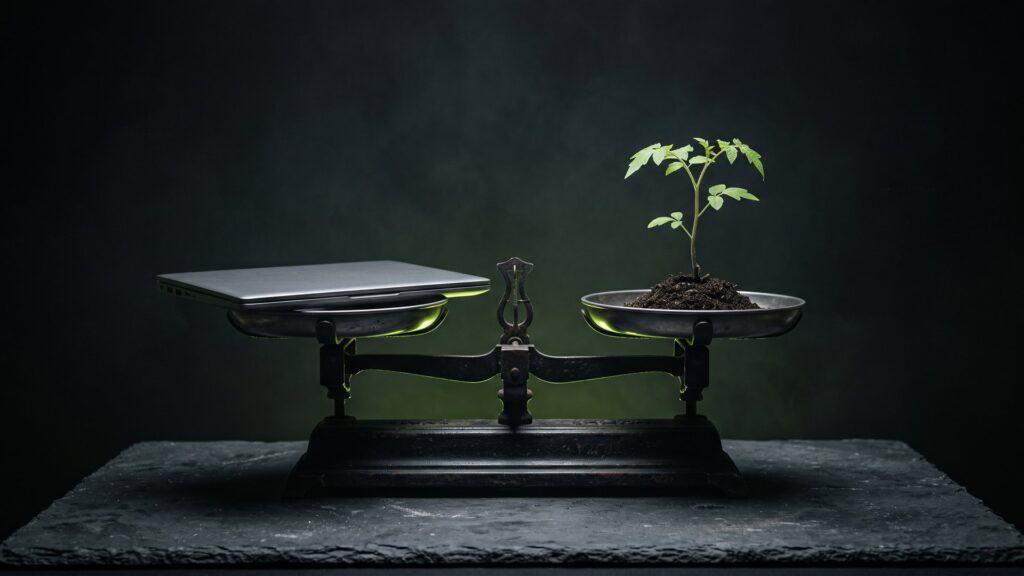
Longer use by a second owner saves resources. According to the Federal Environment Agency, a new notebook that is 10 times more % energy efficient would have to be used for over 80 years before its production costs are offset by the old device. Therefore, by passing on functioning devices, one not only improves one’s own liquidity but also the environmental balance.
What the IT department can do to increase the residual value
The residual value does not arise only at the time of sale, but during the entire use phase. With a few simple habits, you can increase the later proceeds:
- Maintain inventory list: Keep the model, serial number, equipment, and location current. This speeds up any subsequent offer.
- Holding together accessories: Do not mix power supplies and docking stations in one box; assign them to the device.
- Avoiding blocking: Organize BIOS passwords and device management so that devices can be released cleanly at the end.
- Equipment protection: Pockets and cases prevent scratches and damage to the display, which can add to the price.
- Sell immediately: Do not store devices as „spare“ equipment for years. A small reserve usually suffices.
New, leased or refurbished?
The question of how long they will last also arises when buying them. Three models are common:
| Model | Typical advantage | What to look out for |
|---|---|---|
| Buy new | Full control, residual value is yours | Plan sales activities actively at the end of the month |
| Leasing | Planable installments, fixed exchange cycle | Clearance of return conditions and data deletion |
| Purchased refurbished | Lower purchase costs, better environmental footprint | Proven quality and warranty |
Frequently Asked Questions about Term of Use and Depreciation
How long is the useful life of a laptop tax-wise?
Since 2021, computer hardware can be depreciated after a letter from the Federal Ministry of Finance stating a useful life of one year. Previously, according to the AfA table, the useful life was three years. For devices priced up to 800 euros net, there is also the immediate write-off as a low-value asset. Which option is suitable, you should clarify with your tax advisor.
May I sell a laptop that has been wiped clean of data?
Yes. A decommissioned device remains part of the operating assets and can be sold. The proceeds are usually recorded as income. Before selling, all data must be deleted in a verifiable manner. A certified remarketer undertakes deletion, verification, and purchase in one step.
How much is a three-year-old business laptop worth?
That cannot be said in a general way. The value depends primarily on the model, processor generation, features, condition, and quantity. However, business laptops are often in high demand on the used market. You can obtain a realistic figure by submitting a list of devices for evaluation.
Is it more economical to use laptops longer or to sell them earlier?
It depends on your usage. Longer use saves on purchasing new equipment, but increases support costs and the risk of downtime. At the same time, the residual value decreases every month. For many companies, it makes sense to sell equipment immediately after replacement rather than letting it age in storage.
What documents do I need to sell old equipment?
For a quote, a list with model, equipment, condition and quantity is sufficient. For your own documentation, after the sale, you should keep the deletion certificates for each device, the billing and, if applicable, the disposal certificates. This way, you can manage accounting, data protection and sustainability reports alike. At Second IT, you receive these documents from a single source.
Converting scrapped equipment into cash – securely deleted.
Send us your list of devices. You will receive your purchase offer within an average of 48 hours.