Skip to content


Smartphones have become an integral part of our everyday lives - but what happens to the devices when they have had their day? Many old devices end up unused in drawers or in household waste, even though they contain valuable raw materials. Smartphone recycling is therefore not only an ecological necessity, but also an important contribution to data protection.
The most important in a nutshell
- Smartphones contain precious metals, copper, and rare earths – but also pollutants. They therefore never belong in household waste.
- Before any phone recycling, data must be erased so that it cannot be recovered – for company phones, with proof for each device.
- Reuse comes before recycling: functional devices are refurbished, and only the rest is broken down into raw materials.
- Never remove built-in batteries yourself – damaged batteries are a fire hazard and require safe transport.
Why old cell phones should be recycled
An average smartphone contains:
- Precious metals such as gold, platinum, silver
- Rare earthswhich are difficult to break down
- Plastics & batterieswhich may contain environmental toxins
Anyone who disposes of these appliances improperly causes environmental pollution and at the same time loses recyclable raw materials. Sustainable Cell phone recycling conserves resources, reduces CO₂ emissions and prevents the release of pollutants.
Cell phone recycling is more than just "throwing away"
Many people think of garbage cans or recycling centers when they think of disposal - but modern recycling means:
- Disassembly of the devices into their individual parts
- Separation of valuable raw materials from harmful substances
- Recycling of functional components
This process must be carried out professionally, documented and securely - especially for smartphones with sensitive data.
What happens to the raw materials in smartphone recycling
After dismantling, the battery, circuit boards, display, and housing are processed separately. A high proportion of the gold, silver, palladium, and copper from the circuit boards can be recovered in specialized smelters. The battery is processed separately to recover metals such as cobalt, nickel, and lithium. Rare earths are so far recycled only to a small extent – which makes it all the more important to use devices for as long as possible.
Don't forget data protection when recycling cell phones
Almost every smartphone contains personal or business data:
- Photos, contacts, messages
- Access data for banking, e-mail or cloud services
- GPS histories and health data
Before a device is recycled, this data must be be deleted completely and unrecoverably - ideally with certified procedures and corresponding documentation.
At Second IT, erasure is performed with Blancco – from smartphones to servers. For every device you receive a digitally signed erasure certificate with the serial number. More on this on our page on certified data deletion.
How does professional smartphone recycling work at Second IT?
Second IT offers a secure and environmentally friendly solution for recycling end-of-life smartphones:
- Device acceptance with documentation
- Certified data erasure with audit trail
- Condition check: recycling or material separation
- Returning recyclable components to the raw materials cycle
- Environmentally friendly disposal of unusable materials
Find out more about our Smartphone recycling and professionally recycled.
Who should use cell phone recycling?
This solution is suitable for:
- Private individualswho want to get rid of old cell phones
- Companieswho have to dispose of decommissioned company cell phones
- Authorities and organizations with high data protection standards
- IT departmentswho regularly replace devices
Regardless of the number of devices Safe and documented disposal mandatory.
Smartphone recycling vs. resale - which is better?
Not all devices have to be recycled. Second IT checks every smartphone for reusability. Two scenarios:
| Condition of device | Procedure |
|---|---|
| Functional | Processing & reuse |
| Defect/old model | Dismantling & recycling |
This separation allows resources to be used in a targeted way and costs to be saved. It also corresponds to the waste hierarchy of the German Circular Economy Act (KrWG): preparation for reuse takes priority over recycling. Many smartphones with minor damage can be restored in our Repair fully operational again.
Common mistakes when disposing of old smartphones
- Simply throw away the device
→ Harmful to the environment & prohibited by law - Data not deleted
→ Data protection risk & GDPR violation - Battery overlooked
→ Fire hazard during transport or storage. Remove removable batteries before handing in the device, but do not remove built-in batteries yourself. Report damaged or swollen batteries when registering.
Second IT helps you to avoid these mistakes - with clear processes, individual advice and certified implementation.
Smartphone recycling for companies: proof for data protection and ESG
For companies, phone recycling is not just an environmental question but also a question of documentation. Data protection officers need erasure records, and sustainability reporting needs figures on recovery. At Second IT, you therefore receive:
- a digitally signed erasure certificate for every single device,
- recycling and disposal records for your CSR and ESG reporting,
- insight into the processing status via the customer portal,
- an annual, individual environmental report.
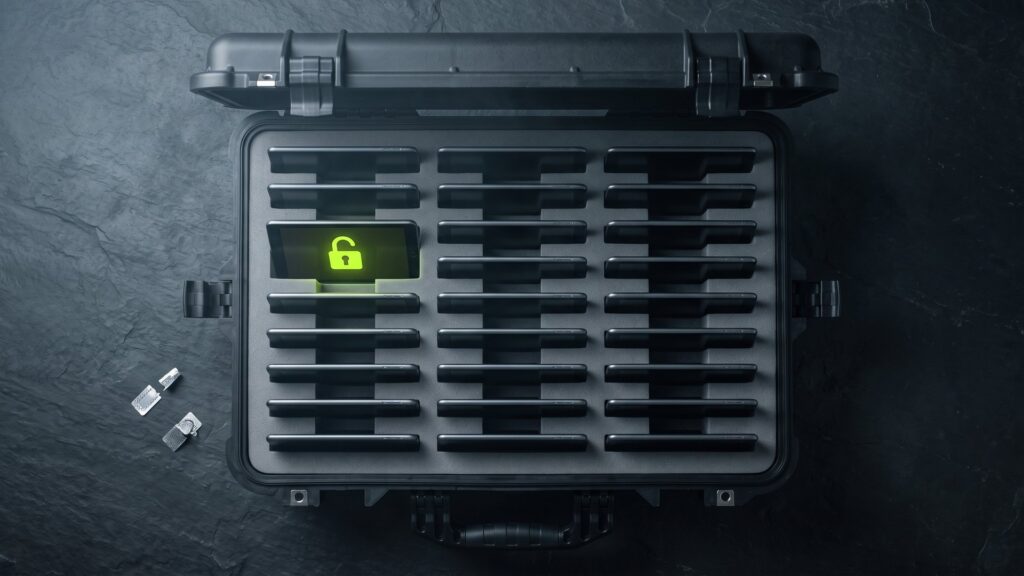
For the secure shipping of smartphones and tablets, there is the PELI Case: a high-security case with two seals per ISO 17712, shipped via DHL. You can read about how we implement sustainability in our own operations on our page on Sustainability.
Before tablets go into recycling, it is worth looking at their residual value: Selling company tablets instead of recycling them.
Your advantages with Second IT
- Legally compliant disposal & data protection
- Environmentally friendly processes with evidence
- Transparent valuation & utilization
- Reliable advice for private & business customers
Thanks to our many years of experience, we offer you a full service that goes far beyond standard recycling. As a certified waste management company under § 56 of the German Circular Economy Act (KrWG), we also take care of the proper disposal of devices that can no longer be used.
Conclusion - cell phone recycling protects the environment & data at the same time
Cell phone recycling and Smartphone recycling are not marginal issues - they are part of a sustainable digital strategy. Disposing of old devices via professional service providers such as Second IT protects the environment, prevents data misuse and complies with the law.
Take the opportunity to do a lot of good with little effort - for your data, your IT security and the environment.
More on the topic: Test drive corporate phones: Data gone, lock gone, money returned and Scope-3 emissions: Why your IT hardware is included.
Frequently asked questions about smartphone recycling
What is meant by smartphone recycling?
Smartphone recycling refers to the proper recovery of end-of-life phones. The devices are dismantled, pollutants are separated, and raw materials such as gold, silver, copper, and cobalt are recovered. Functional components or entire devices are reused where possible. Before every step, the data must be securely erased.
How is data erased before phone recycling?
Professional service providers erase smartphones with certified software such as Blancco and create a report for each device. The report states the serial number, method, and result of the erasure. If a device can no longer be switched on, the storage is physically destroyed. This ensures that no data falls into the wrong hands.
May I remove my smartphone's battery myself before recycling?
Only if it can be removed without tools. In most current smartphones, the battery is firmly glued in. Removing it by force can damage the battery and cause a fire. Therefore hand in such devices completely and report damaged or swollen batteries in advance.
Is recycling or reuse better for the environment?
Reuse is almost always better. Most of a smartphone's environmental impact arises during manufacturing. Each additional year of use therefore saves raw materials and energy. Recycling is the right route for devices that can no longer be repaired or refurbished economically.
What records do companies receive for phone recycling?
At Second IT, companies receive a digitally signed erasure certificate for every device as well as recycling and disposal records. These documents are suitable for documentation under the GDPR and for CSR and ESG reporting. You can track the processing status in the customer portal. In addition, there is an annual, individual environmental report.
Recycle or sell company phones – securely erased, cleanly documented.
Send us your device list. You will receive an offer in 48 hours on average.