
 Skip to content

Sicherheitstransport
Between your office and the certified data erasure lies a stretch that is missing from many data protection concepts: transport. Pallets of notebooks, crates full of hard drives, or an entire server rack are on the road before the data is erased. A secure transport closes this gap. This glossary entry explains what makes up a secure transport, which documentation belongs with it, and how to recognize quality.
In brief
A secure transport is the carriage of data carriers or IT devices under conditions that prevent unauthorized access en route and document every step. Typical building blocks are sealed containers or vehicles, GPS tracking, direct trips without intermediate storage, trained personnel, and a handover with a serial number list. In IT decommissioning, secure transport protects the data until it has been verifiably erased or destroyed.
What does secure transport mean?
A normal transport is meant to bring goods to their destination undamaged and on time. A secure transport has an additional goal: no one should get at the data on the devices along the way – and if something does happen, it must be noticed immediately. The term is also used for cash-in-transit. In IT it stands for the route of decommissioned hardware to the service provider who erases, destroys, or refurbishes it.
In this context the term secure logistics often comes up. It encompasses more than the trip: planning, packaging, sealing, collection, transport, handover, and documentation together make up secure logistics. Secure transport is its core.
Why transport matters
Art. 32 GDPR requires protective measures that are appropriate to the risk. This applies to every phase of processing, including transport. If a crate of unencrypted hard drives is lost, this can be a reportable data breach. Anyone who decommissions IT remains responsible for the data until erasure is documented.
The DIN 66399 standard, in Part 3, also looks at the entire process of data carrier destruction – from collection through transport and storage to documentation. The higher the protection class of the data, the stricter the requirements. A secure transport is therefore a link in the Chain of custody, that is, the unbroken chain of custody of every device.
Components of a secure transport
| Component | Purpose | Proof |
|---|---|---|
| Sealing | Containers or cargo space cannot be opened unnoticed | Seal numbers in the handover record |
| GPS tracking | Vehicle can be tracked in real time, deviations are noticed | Trip log, live tracking |
| Direct transport | No reloading, no intermediate storage with third parties | Departure and arrival time |
| Closed vehicle | No access from outside, for example through a tarpaulin | Vehicle details |
| Trained personnel | Drivers know the procedure and how to behave in the event of incidents | Confidentiality undertaking |
| Insurance | Protection against loss and damage to the devices | Proof of insurance |
| Handover with serial numbers | Every device is uniquely recorded at collection and arrival | Handover record, goods receipt list |
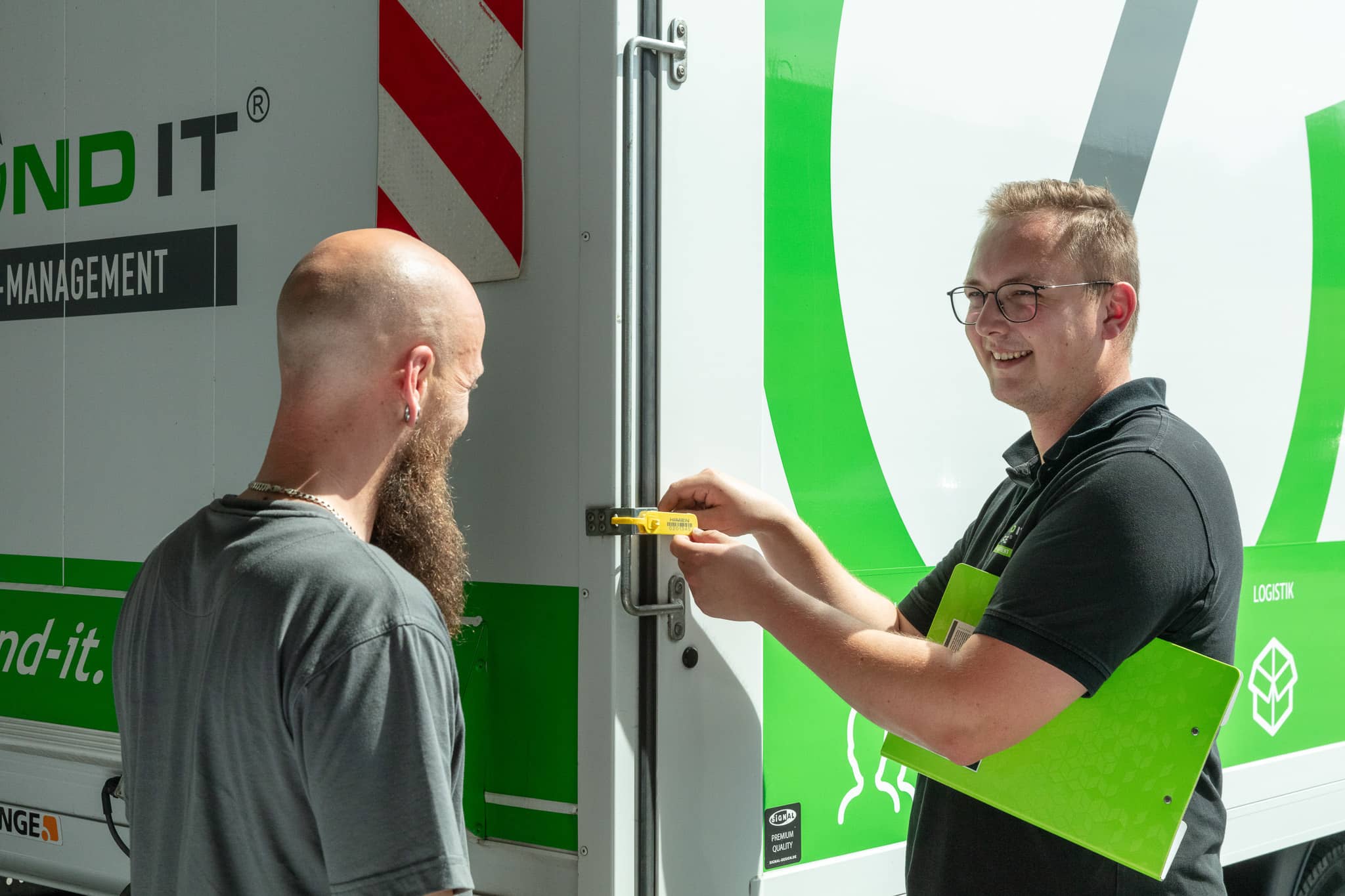
the Security seal shows every attempt to open. It does not prevent it but makes it visible. The Direct transport shortens the time devices are on the road and avoids storage facilities where unknown persons could have access.
Key takeaway: A secure transport is only as good as its gaps. What is decisive is that between your signature and the opening of the seal at the service provider, no one gets at the devices unnoticed.
How to recognize a good secure transport
- Own vehicles and own personnel: Does the service provider drive itself or pass the order on to a freight forwarder? Every additional party lengthens the chain.
- Unsealing only at the destination: The seal should be opened only in the service provider's secured area, ideally with a check of the seal number.
- No Interim storage: Ask whether devices stay overnight in a depot.
- Clear transfer of risk: From when is the service provider liable? This should be regulated in the contract.
- Counting and reconciliation: The quantity at collection must match the goods receipt list. Deviations must be reported.
Practical example: collection after a hardware replacement
A simplified example: a company has replaced 120 notebooks, 60 monitors, and 4 servers. This is how a secure transport proceeds:
- Preparation: The company sends a device list with serial numbers. The service provider plans vehicle, packaging, and appointment.
- Packing on site: The logistics team packs the devices. Data carriers are placed in sealed containers, and the seal numbers are noted.
- Handover: Both sides count the devices and sign the handover record. The vehicle is sealed.
- Trip: The vehicle drives directly to the service provider's site, monitored by GPS.
- Arrival: In the secured area, the seal is checked and opened. Every device is recorded at goods receipt by serial number.
- Conclusion: The company sees the status online and later receives an erasure or destruction certificate for each device.
In the case of business closures or relocations, time pressure is often high. Precisely then, a planned secure transport is worthwhile. Tips on this can be found in the guides on Business closure and the IT relocation.
Distinction from related terms
- Parcel shipping: Parcels pass through sorting centers and several vehicles. For individual devices this may be acceptable with a sealed security case, but not for large quantities of unprotected data carriers.
- Reverse Logistics: Reverse logistics is the umbrella term for all return flows of goods. Secure transport is its especially protected form for data carriers.
- Cash-in-transit: It protects mainly the material value, for example cash. With IT secure transport, the protection of the data is the priority.
Secure transport at Second IT
Second IT operates its own secure logistics. Collection is carried out as a direct trip without intermediate storage, with GPS monitoring, tamper-proof sealing, and insured transport. According to the terms and conditions, all data carriers are sealed during on-site collection; vehicles with a tarpaulin are not permitted for this. Unsealing takes place only on our premises in Schwäbisch Hall. Every process step is documented, and a trained logistics team handles packaging and transport – Europe-wide.
At goods receipt, all devices are checked for storage media and registered by serial number. In the customer portal you follow the status live. For smaller quantities there is the PELI Case with two seals in accordance with ISO 17712 as well as the roll cage. More on the Secure logistics by Second IT.
Frequently asked questions about secure transport
Is a secure transport required by law?
There is no law with the word "secure transport". The GDPR does, however, require appropriate protective measures for personal data, including during transport. For hard drives with customer or personnel data, a protected transport is therefore generally the appropriate measure.
What is a direct run?
In a direct trip, the vehicle drives from the collection location to the destination without reloading and without intermediate storage. That way there is no station at which third parties could have access to the devices.
Is it enough to ship the devices by parcel service?
For individual devices, a sealed, robust security case can be a solution. For larger quantities or data carriers with a high protection requirement, a collection with a direct trip is safer because the devices do not pass through sorting centers.
When does responsibility pass to the service provider?
The contract regulates that. The risk often passes with the handover or the sealing at the collection location. For data protection you remain responsible as the controller and therefore need a data processing agreement and documentation for each device.
Which documentation belongs to a secure transport?
Typical are a handover record with seal numbers, a trip log or live tracking, proof of insurance, and a goods receipt list with serial numbers. The quantity at collection must match the goods receipt list.
Related terms
Collection with our own secure logistics – sealed, GPS-monitored, direct.
Send us your device list. You will receive your offer in 48 hours on average.