
 Skip to content

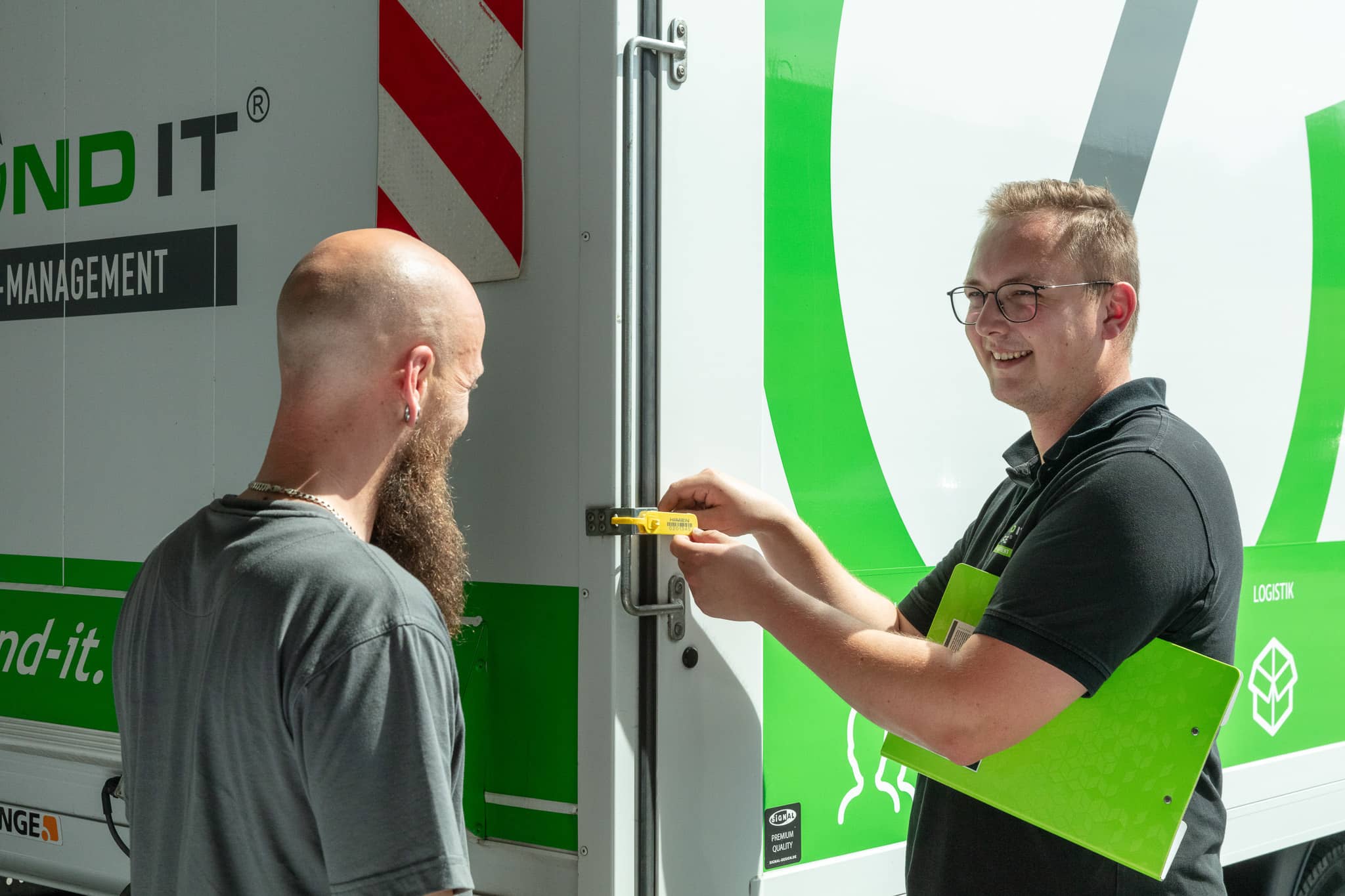
Sicherheitsplombe
Between your office and the service provider lie a stairwell, a loading dock, and a highway. Along this route, notebooks and hard drives containing company data should fall into no one's hands. A security seal does not prevent this on its own, but it makes visible whether a container was opened along the way. This glossary entry explains how security seals work, which types exist, and what to look out for when sealing.
In brief
Security seals are numbered closures that secure a container, a door, or a vehicle in such a way that any opening leaves visible traces. They are "tamper evident": a seal can be removed only by destroying it. When decommissioned IT is transported, intact seals with a documented number prove that no one gained unauthorized access to the data carriers.
What is a security seal?
A seal (Plombe) was originally a lead seal used to close sacks, meters, or doors. Today security seals are usually made of plastic, steel, or steel cable. What all types have in common: they bear a unique, sequential number and cannot be opened after closing without visibly damaging them.
This gives rise to their purpose. A seal is not a lock that prevents a break-in. It is evidence. Whoever opens the container leaves traces, and whoever swaps a seal produces a wrong number. Both are noticed by the recipient when they compare the number with the record.
In English, one speaks of "security seals" and "tamper-evident seals". What is meant is always the same principle: manipulation does not become impossible, but it does not go unnoticed.
Why security seals matter in IT transport
Decommissioned notebooks, PCs, servers, and hard drives are, until erasure, data carriers with customer, personnel, or business data. Art. 32 GDPR applies to them: personal data must be protected by suitable technical and organizational measures, including during transport. At the same time, the accountability principle (Art. 5(2) GDPR) requires that you can demonstrate this protection.
The seal closes a gap that other measures leave open. GPS data shows where a vehicle was. It does not show, however, whether a container was opened. The intact seal with the matching number is the proof that the contents arrive at the recipient as they were closed at the sender. It is thus a link in the Chain of custody, the unbroken chain of custody.
Types of security seals
| Type | Structure | Typical use |
|---|---|---|
| Plastic seal (pull-tight seal) | Plastic strap with a locking closure, can be opened only by cutting | Containers, security containers, roll cages, crates |
| Cable seal | Steel cable with a locking body, is pulled tight | Doors of vehicles, wire mesh pallet boxes |
| Bolt seal | Steel bolt with a sleeve, can be separated only with a tool | Containers and truck bodies |
| Security label | Adhesive seal that leaves a message such as "VOID" when peeled off | Housings, cartons, drive bays |
For mechanical seals in container transport there is the international standard ISO 17712. It distinguishes seals by their resistance into the classes I (Indicative), S (Security), and H (High Security). Class H seals must withstand particularly high forces and can be separated only with heavy tools.
Key takeaway: A seal is only as valuable as the record in which its number is entered. Without a documented number, it is decoration.
How to recognize secure sealing
- Unique numbers: Every seal has its own sequential number. Duplicate or missing numbers are noticed immediately.
- Number in the handover record: The seal numbers are entered in the Acceptance recordthat is signed at collection.
- Check by the recipient: At goods receipt, the condition and number of each seal are checked before the container is opened.
- Open only at the destination: The seal is removed only where processing takes place, not at an intermediate stop.
- Rule for deviations: If a seal is damaged or the number does not match, this is documented and reported before work continues.
- Controlled seal stock: Unused seals are stored locked so that no one can insert a replacement seal with a matching appearance.
Example: collection from three branch offices
A simplified example shows how seals help in practice. A company has decommissioned notebooks collected from three branch offices.
- In each branch office the devices are packed into a container. IT notes the serial numbers and the number of the seal with which the container is closed.
- The driver checks the closure and signs the handover record with the seal number and the number of containers.
- At goods receipt it turns out: two seals are intact, on the third the number does not match the record.
- The container is opened separately, the contents are checked against the device list, and the deviation is reported. It turns out that in the branch office two seals were noted swapped. All devices are complete.
Without seal numbers, no one would have noticed that something was wrong. With them, the deviation could be clarified and documented in a short time. How to organize the handover of devices when employees leave is shown by our offboarding checklist.
Security seals at Second IT
With the Secure logistics by Second IT every transport is protected by tamper-proof sealing. According to the terms and conditions, secure logistics for on-site collection includes sealing of all data carriers as well as GPS tracking of the vehicle. Unsealing takes place only on our premises in Schwäbisch Hall. The trips are direct trips without intermediate storage, and the transport is insured.
Anyone who ships devices themselves receives suitable seals with them: every PELI Case contains two high-security seals in accordance with ISO 17712:2013. The roll cage is also closed with supplied security seals. When handing over to DHL or the freight forwarder, have the pickup acknowledged on your copy of the handover record. At goods receipt, the devices are then registered by serial number.
Distinction from related terms
The security seal secures the container. The Secure transport covers the entire route with vehicle, route, personnel, and documentation. A Data protection container is a lockable collection container that is often additionally sealed. What matters overall for the data-protection-compliant handling of data carriers is explained in our guide Disposing of data carriers in GDPR-compliant fashion.
Frequently asked questions about security seals
What does "tamper evident" mean?
"Tamper evident" means that manipulation is indicated. Such a closure does not completely prevent opening but makes it visible. Whoever opens or swaps it leaves traces or a wrong number.
What does ISO 17712 regulate?
ISO 17712 is an international standard for mechanical seals, mainly in container transport. It sets requirements for strength and tamper indication and divides seals into the classes I, S, and H. H stands for high-security seals.
What should I do if a seal arrives damaged?
Do not simply open the container, but photograph and document the condition. Then the contents are checked in a controlled manner against the device list. If a device containing personal data is missing, check with your data protection advisor whether a notification under Art. 33 GDPR is necessary.
Is a seal enough protection when shipping?
Not on its own. The seal indicates manipulation but does not prevent loss. A combination of a sturdy container, a documented seal number, traceable transport, and checking at goods receipt makes sense.
What is the difference between a seal and a lock?
A lock is meant to prevent access. A seal does not prevent it, it makes it visible. Whoever opens it leaves traces, and whoever swaps it produces a wrong number. Both are noticed when compared with the record.
Related terms
Collected sealed, unsealed only on our premises – with documentation for each serial number.
Send us your device list. You will receive your offer in 48 hours on average.