
 Skip to content

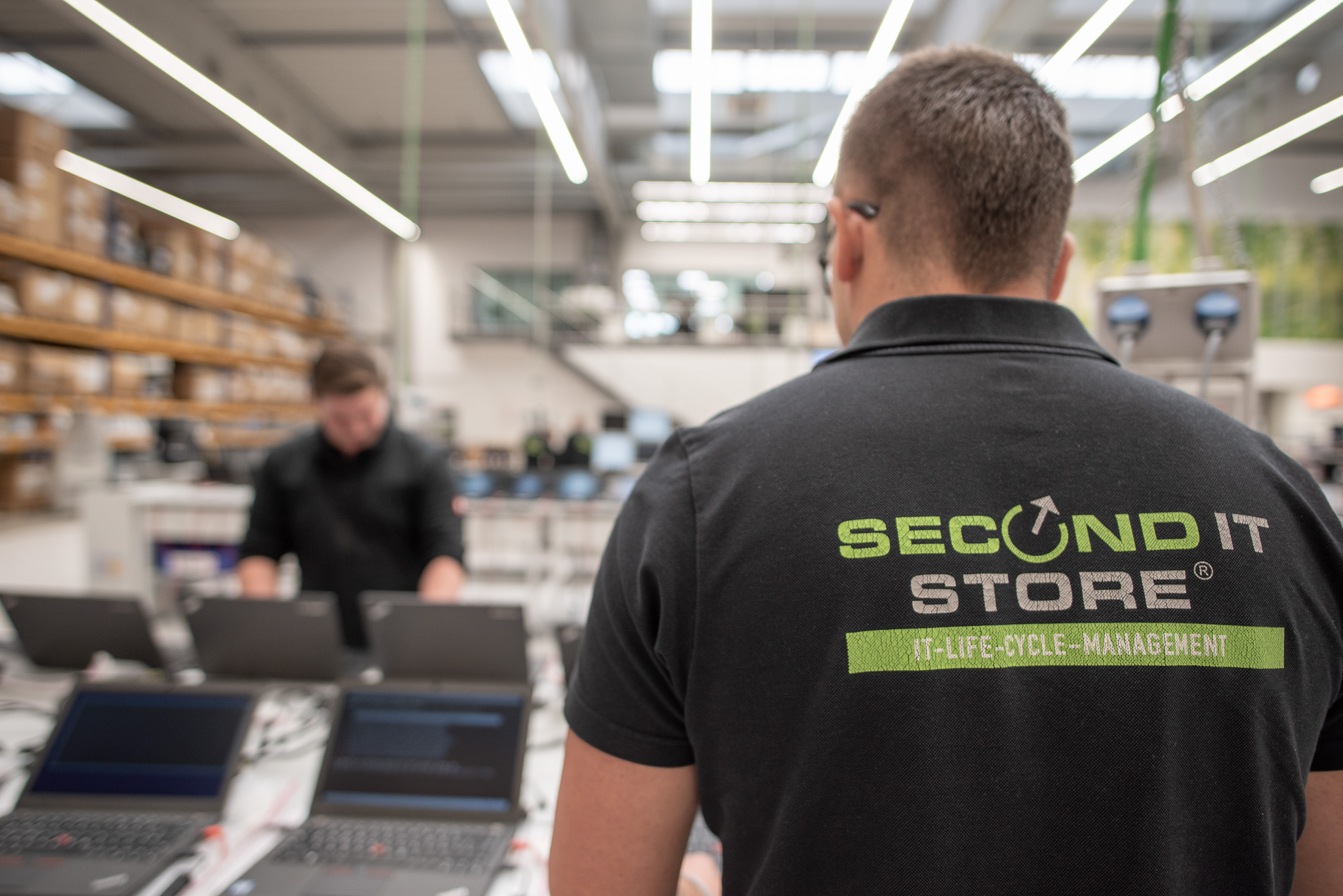
Almost every current notebook and many servers store their data on SSDs today. They are faster and more robust than classic hard drives. When erasing, however, they behave fundamentally differently – and that is decisive for decommissioning.
In brief
An SSD (Solid State Drive) is a data storage device that stores data electronically in flash memory chips, without moving parts. A dedicated controller distributes write operations across the memory cells and manages spare blocks. For this reason, an SSD cannot be erased reliably by simple overwriting; firmware commands such as Sanitize, a Crypto Erase, or physical destruction are secure.
What is an SSD?
SSD stands for Solid State Drive, literally "solid-state drive". Unlike a HDD it has no rotating platters and no read/write head. The data resides in NAND flash memory, that is, in chips that retain their content even without power.
SSDs come in various form factors and with various interfaces. Widespread are 2.5-inch drives with a SATA connector and small plug-in cards in the M.2 format, often with NVMeinterface. In smartphones, tablets, and some notebooks, the flash memory is soldered directly onto the circuit board.
Structure and how it works
Flash cells tolerate only a limited number of write operations. The SSD's controller therefore distributes the write load evenly. This method is called Wear leveling. A file that you change therefore usually ends up in a new location. The old version initially remains. In addition, the SSD keeps spare blocks that are invisible to the operating system. This is referred to as Over-provisioning.
| Feature | SSD | HDD |
|---|---|---|
| Storage technology | Electronically in flash chips | Magnetically on rotating platters |
| Moving parts | No | Platters, motor, read/write head |
| Where data ends up | Controller decides, changing cells | Fixed address on the platter |
| Erasing by overwriting | Not reliable | Proven, with verification |
| Suitable erasure methods | Sanitize commands, Crypto Erase, Secure Erase | Overwriting, firmware commands |
| DIN 66399 material class | E (electronic data carriers) | H (hard drives) |
What to note when retiring devices
Erasing: Because the controller decides where data resides, software from the outside does not reliably reach every cell. Commands that the SSD executes itself are more reliable, such as Sanitize or a Crypto Erasein which the internal key is replaced. A subsequent check and a report for each serial number are important. Which methods are suitable for which drive is explained in our guide Securely erasing hard drives and SSDs.
Destroying: If an SSD cannot be erased, it is physically destroyed. Under DIN 66399 it belongs to the Material class E. Because a single flash chip holds a lot of data, significantly smaller particles are needed than with hard drives.
Key takeaway: An SSD does not forget by being overwritten. It must be erased or destroyed with its own commands.
SSDs at Second IT
At Second IT, SSDs and HDDs are erased software-based with Blancco, including hidden areas such as HPA and DCO. A digitally signed erasure certificate with a serial number is provided for every device. Data carriers that cannot be erased in an audit-proof manner for technical reasons are destroyed in-house in accordance with DIN 66399 and documented with a certificate of destruction. Erased devices with an intact SSD can be refurbished and resold. More on the certified data deletion.
Frequently asked questions about SSDs
What is the difference between an SSD and a hard drive?
A hard drive (HDD) stores magnetically on rotating platters, an SSD electronically in flash chips without moving parts. SSDs are faster and more shock-resistant but require different methods for erasure.
Is formatting enough to erase an SSD?
No. Formatting does not reliably remove the data. Use verified erasure methods with firmware commands and have the erasure confirmed for each serial number.
Can an SSD be shredded like a hard drive?
In principle yes, but with finer shredding. DIN 66399 assigns SSDs to material class E. A level for hard drives can leave intact memory chips behind on SSDs.
How do I erase an SSD securely?
Reliable are commands that the SSD executes itself, such as Sanitize or a Crypto Erase in which the internal key is replaced. A subsequent check and a report for each serial number are important. If the SSD cannot be erased, it is physically destroyed.
What is wear leveling and why does it matter for erasure?
Flash cells tolerate only a limited number of write operations. The controller therefore distributes the write load evenly. A changed file usually ends up in a new location, and the old version initially remains. Overwriting from the outside does not reliably reach these remnants.
Related terms
Erase SSDs verifiably – with a digitally signed certificate for each device.
Send us your device list. You will receive your offer in 48 hours on average.